Or: The curious case of the Knowledge Graph box
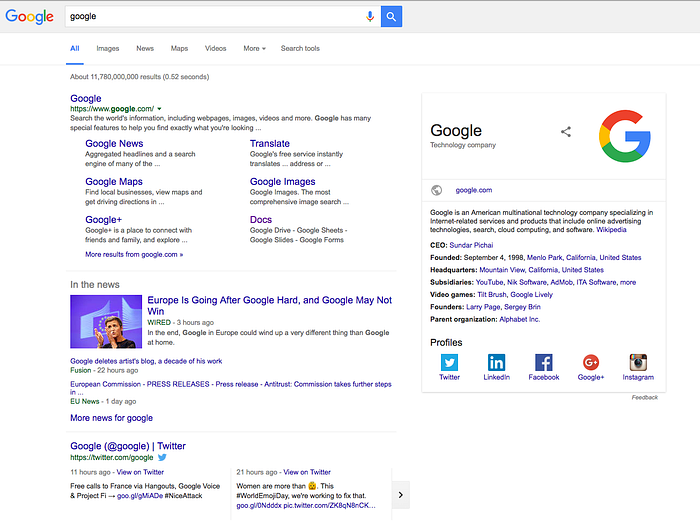
One of the first things I’ve done while researching about the company I was applying to, was of course Googling it.
A quick look at the search results page (SERP) showed their recent round of investments and major social profiles.
What I found to be missing is the Knowledge Graph (KG) box with the company’s information.
This box is auto-generated by Google for distinguished search terms. For these it instantly provides a clear answer, the company’s details in this case or a pancake recipe for another search.
When I ultimately started my position, one of my first tasks was addressing a competitor promoting paid ads on our brand in Google Search . Looking at the SERP I assumed the more ‘real estate’ we can grab, the less focus the competitor will get (aside from the bidding games I played with them).
I could safely assume that we would be eligible based on our branded search volumes, surely compared to smaller competitors that had their KG box showing.
And so I set out to land that evasive box.
Step 1 — Microdata
The immediate suspect was the microdata tagging of the homepage. This was an easy task to tackle. Quickly spun the JSON snippet with our company data, injected it to the code and pinged Google.
And then we waited.
And waited some more.
And some more.
No change.
Step 2 — Wikidata
The second place I like to visit is Wikidata. We already had a good Wikipedia page so I figured I’d complement it with a Wikidata one.
Wikidata is a free and open knowledge base that can be read and edited by both humans and machines. Wikidata acts as central storage for the structured data of its Wikimedia sister projects
Simply put, Wikidata is microdata editor for Wikipedia.
Entity created. Easy as pie.
Still no change.
Step 3 — Digging deeper
It was getting obvious that something is essentially broken.
My next step in auditing the problem was searching for our brand on Google’s Knowledge Graph API. This should help in trying to understand what Google correlates our brand with.
Yes, this might have more reasonable to do at an earlier stage but I didn’t think that was needed. Lesson learned.
The API’s result caught me by surprise. Our brand’s name was most associated with, well, another company’s brand. This was due to our Wikipedia page pointing out a partnership between the two companies.
OK. So we know what is associated with us. But why the heck aren’t we simply listed as a company that’s doing business with another company?
Step 4 — Outsmarted by Wikipedia
The specific partnership was mentioned on our Wikipedia page, which was also the source for the API’s result.
Going over our Wikipedia page I’ve noticed something interesting.
We are a Software company. That’s we do. But our page’s infobox scheme was that of a Software.
So a quick edit was done on the page. Creating a main infobox Company for the page with two nested boxes as Software per each product line.
Boom.
In a couple of days Google understood the change and we landed the long awaited KG box.
It’s also interesting to note that our correlation score with the other company hasn’t changed at all, as it still true. But a far greater score was given to our actual brand.
Final thoughts
My first takeaway here s that Wikipedia is still a big indicator to Google. Maybe it is the manual editing that Google trusts. Whatever the case is, understanding its nuances can be valuable for Organic work.
With its credibility so high (apparently), this also got me questioning the value of outbound links from Wikipedia pages. While these automatically carry the nofollow attribute (blocking any link juice flow between sites), it might very well be that Google acknowledges these to some extent.
Another takeaway is that if you brand isn’t getting your branded KG box, maybe its simply because you’re misunderstood.